Best Practice Corporate Governance for Net Promoter Score Success
Without explicit governance, a transactional NPS program drifts back to whoever has the loudest objection. Best practice uses two specific groups, a Steering Committee and a Process Team, operating in a three-layer model. Here's the membership of each, what they're responsible for, and how the model holds the program steady through executive churn.
On this page
When rolling out a transactional customer feedback process such as Net Promoter you need a corporate governance process that will deliver success. Best practice experience suggest two critical groups are needed: Steering Committee and Process Team.
In this post we discuss the role of each group and how you can build long term success.
NPS Corporate Governance
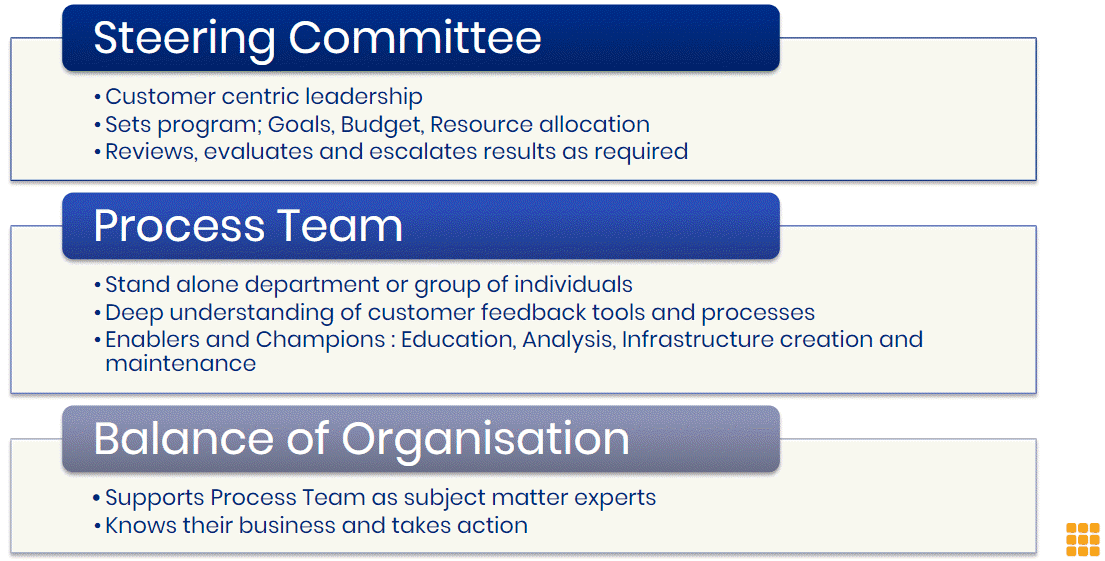
In our best practice NPS governance model there are three layers, each delivering part of the solution.
Steering Committee
This group has the overall responsibility for guiding and supporting the transactional customer feedback process within the organisation.
This group of, generally, senior executives meet on a regular basis to review progress, assign budgets, review and evaluate goals, etc. of the overall process.
In the rollout stages this group is especially important as a driving force to:
- clear operational and staffing roadblocks,
- allocate budget as required and
- vocally support the move to a Net Promoter approach.
The role of the Steering Committee as a visible and vocal supporter of the change to transactional customer feedback collection and action is particularly important in the first 6 months of the move to Net Promoter.
It is in this stage that staff are naturally the most sceptical about the change and it is in this period when clear and present senior management support can bring people on board. Lack of that support may imply to staff that they can wait it out until the next management fad comes along.
During the rollout phase this team might meet on a two-weekly or monthly basis but longer term will normally meet on a two-monthly or quarterly basis. They are an approval and oversight group not an operational group.
Membership
Membership of this group should be senior executives within the division or company. Including the CEO, COO, Managing Director on the team is particularly valuable. In addition, senior leaders of key operational groups (call centres, distribution, etc.) are also excellent candidates for a place on this team.
One member on this team should be designated the Executive Sponsor of the process. It is this person who will liaise with Process Team on a regular basis and it is to this person that the team will nominally report.
This governance structure is one item on a longer list of things that separate programs that stick from programs that fade after 12 months: see our 41 NPS best-practice tips for the rest.
Process Team
The other key group in the implementation of transactional customer feedback is the Process Team. The role of this group is to bring knowledge and understanding of the process to the rest of the organisation.
Typically in the early part of the rollout the Process Team will be more engaged in the development and setup of the data collection and analysis tools required to collect and use the customer feedback.
However, when the system is setup, their roll will evolve to one of education and supporting of the rest of the organisation in using the transactional feedback system. They will also be instrumental in supporting specific data analysis projects and work with the rest of the company to understand and use the information collected.
Membership
Some people suggest that this group should be a full-time standalone person, department or group within the company. In contrast our suggestion is that it be a cross functional group who take time from their day to day tasks to be part of the team.
This cross functional approach has a number of advantages:
- Additional budget does not need to be allocated to the hiring and support of a separate team.
- The team members are already embedded in the business: rather than have an external department team impose their need to “help” the operational units, the team members are already part of the operations. Help comes from the inside out. Because the business units already trust their own staff, they are more willing to accept suggestions.
- The team builds cross functional links: building cross functional links within the organisation is a healthy way to improve innovation and cross fertilisation within all companies.
The team members can be taken from operational areas such as call centres, services, support, etc. They can also be a mix of more senior and more junior staff.
Membership of the Process Team should be presented as aspirational for all staff. It should be remembered that members will present, on occasion, to the Steering Committee and so will provide them team with incremental visibility at senior management levels.
The skill set of the Process Team will evolve over time. Initially however, it will probably include more some members with more knowledge of the technical and data systems within the organisation. These skills are needed to support the implementation of the data collection and analysis system.
Longer term the team should consist of one or two staff with a more data analysis based skill set and the balance being operational staff. All members should be supporters of the approach and be keen to educate and help other staff.