Understanding and Using the Marketing Customer Journey
Treat the marketing funnel as one big undifferentiated pile of leads and you'll write copy that suits no-one in particular. Awareness, consideration and decision are different problems requiring different content and different offers. Here's the three-stage marketing customer journey, with what to do at each stage and where most teams confuse one stage for another.
On this page
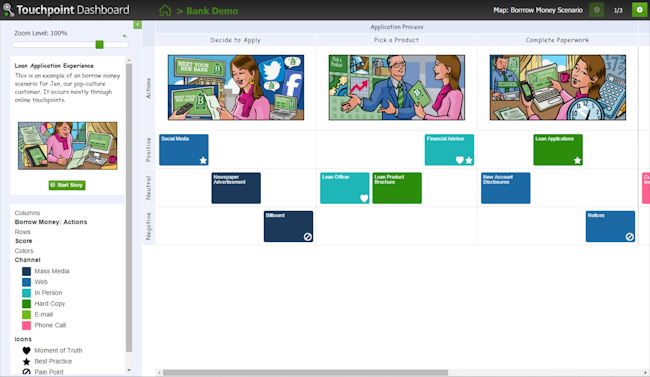
In order to turn prospects into customers, you need to have a solid customer journey marketing strategy. This is the process of creating marketing strategies for each stage of the pre-purchase customer journey, to maximise sales.
In this post we’ll look at the three stages of the marketing customer journey and what to do at each stage to be successful.
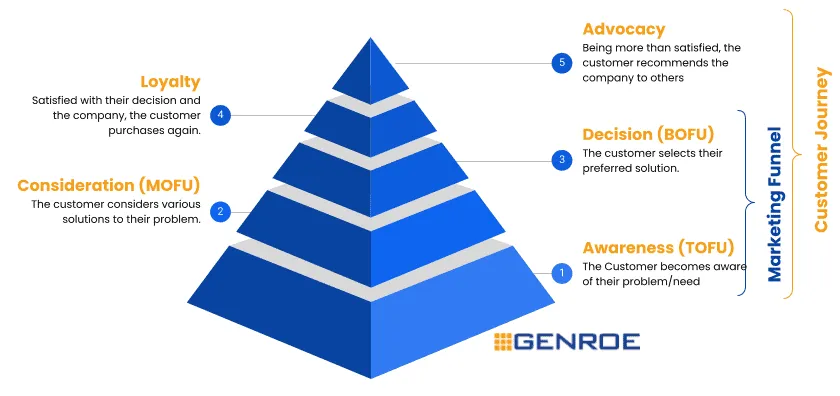
Note that the Marketing Customer Journey can also be called the Marketing Funnel.
Stage 1: Awareness (Problem Identification)
Awareness Definition
The Awareness stage of the marketing customer journey is where the buyer identifies that they have a problem that needs solving.
Let’s say your business is airport transport services in Sydney Australia.
Your prospect is planning a trip to Sydney, Australia and they’ve already booked a hotel in the main downtown district. Now they’re wondering how they will get from the airport to the hotel.
The Awareness stage of the customer journey would be typified by the question:
How far is it from the airport to the hotel? Can I walk or do I need transport?
A quick Google Maps search tells them it’s about 15km from the airport to the hotel. So, walking is probably not going to be appropriate.
Marketing for the Awareness Stage
Marketing materials at this stage of the customer journey are often called TOFU or Top of the Funnel.
You need to focus on the helping the prospect
- Identify or refine their understanding of the problem
- Start them down the track to a solution
- Amplify the importance of the problem
Continuing on with our travel example, appropriate marketing communications for this stage of the customer journey could include:
- A blog post on the distances to different airports around the world
- Social media advertising on the danger of walking alone between the Airport and CBD in Sydney (in reality it’s no more dangerous than any other big city)
- Google Ads campaign offering a “free travel distance” calculator
Stage 2: Consideration (Search for Solutions)
Consideration Definition
The next step for marketing to address in the customer journey, is the prospect searching for a solution to the problem that has been identified.
In our example the prospect is going to be searching for alternatives to walking to the CBD and the Consideration stage of the journey can be typified by the question:
What are the transport options from Sydney Airport to the CBD.
A prospect might:
- Call the hotel for a recommendation
- Search to see if Uber operates in Sydney (it does),
- See if taxi’s operate in Sydney (they do)
- Check for a train line and whether stations are close to the airport and hotel (there is).
Marketing for the Consideration Stage
Marketing materials at this stage of the customer journey are often called MOFU or Middle of the Funnel.
Here the focus is on helping the prospect understand the different options. Examples of customer journey marketing at the Consideration stage include:
- Social media stories by people that have taken different transport approaches
- Blog posts about Uber and train services in Sydney and their alternatives
Stage 3: Decision (search for Purchase)
Decision Definition
Lastly, your prospect needs to make a decision on what they will actually purchase.
The question they’re trying to answer is:
What is the “best” way to get from Sydney Airport to the CBD
Marketing for The Decision Stage
Marketing materials at this stage of the customer journey are often called BOFU or Bottom of the Funnel.
At this point the marketing customer journey is all about pushing your specific solution and why it’s best.
- A blog post on the pros / cons and costs of each different transport approach
- Social media advertising on the pros of your specific transport option
- Negative social media stories by people that didn’t take your specific transport option
- Leveraging positive on-line reviews (social validation)
Putting the Marketing Customer Journey Together
As your prospect moves through these stages of the marketing customer journey you need to be there to help and guide them.
Importantly you need to match the marketing materials you provide to the question they are currently asking themselves.
The airport transport example has been a very simple one but it highlights the need to address the different stages with different content.
Using Google Ads to promote your on-line reviews and targeting the keywords “distance sydney airport to cbd” is giving the prospect the wrong information at the wrong time and is unlikely to be effective.
On the other hand, using Google Ads to promote a “free travel distance calculator ”and targeting the keywords “distance sydney airport to cbd” is giving the prospect the right information at the right time and is more likely to be effective.
Customer Journey Marketing FAQ
Customer Journey Vs Marketing Funnel – what is the difference?
The difference between the Marketing funnel and Customer Journey is that the Marketing Funnel is a subset of the Customer Journey. The Customer Journey includes all the steps from Awareness to Advocacy. Whereas the Marketing Funnel starts at Awareness and stops at Decision.