Net Promoter Score vs Likert Scales
Is the NPS scale a Likert scale? It's a question that comes up in survey-design arguments more often than you'd think, and the answer matters for how you analyse the data. Here's the short version, with the bit most articles get wrong.

On this page
It is common to confuse Likert Scales and Net Promoter Score because the Net Promoter Score scale is a Likert Scale.
In this post we review what they are, how they are similar and how they are different
What is a Likert Scale?
Likert Scales are a specific type of survey question and response format that is often used in market research and customer feedback surveys.
They are characterised by having response items that range from one extreme to the opposite extreme.
They are often in the format of a statement and asking the respondent how much they agree or disagree with the statement, but this is not a requirement to be a Likert Scale.

5 Point Likert Scale Example
Analysis of the data is done on the basis that the response is linear, i.e. the value difference between each two responses is the same, i.e. the difference in feeling between a Strongly Disagree and Disagree, and Neutral and Agree is the same.
In practical customer feedback this type of scale is human perception based and it is unlikely that the difference between a Strongly Disagree and Disagree is the same as between Neutral and Agree, but we make that assumption for simplicities sake.
Likert Scales are typically split in to five or seven values, exclude the Not Applicable option.

7 Point Likert Scale Example
What is Net Promoter Score®
Net Promoter Score, or NPS®, is a specific customer survey question and analysis approach used by companies, large and small, to measure customer experience and predict customer loyalty.
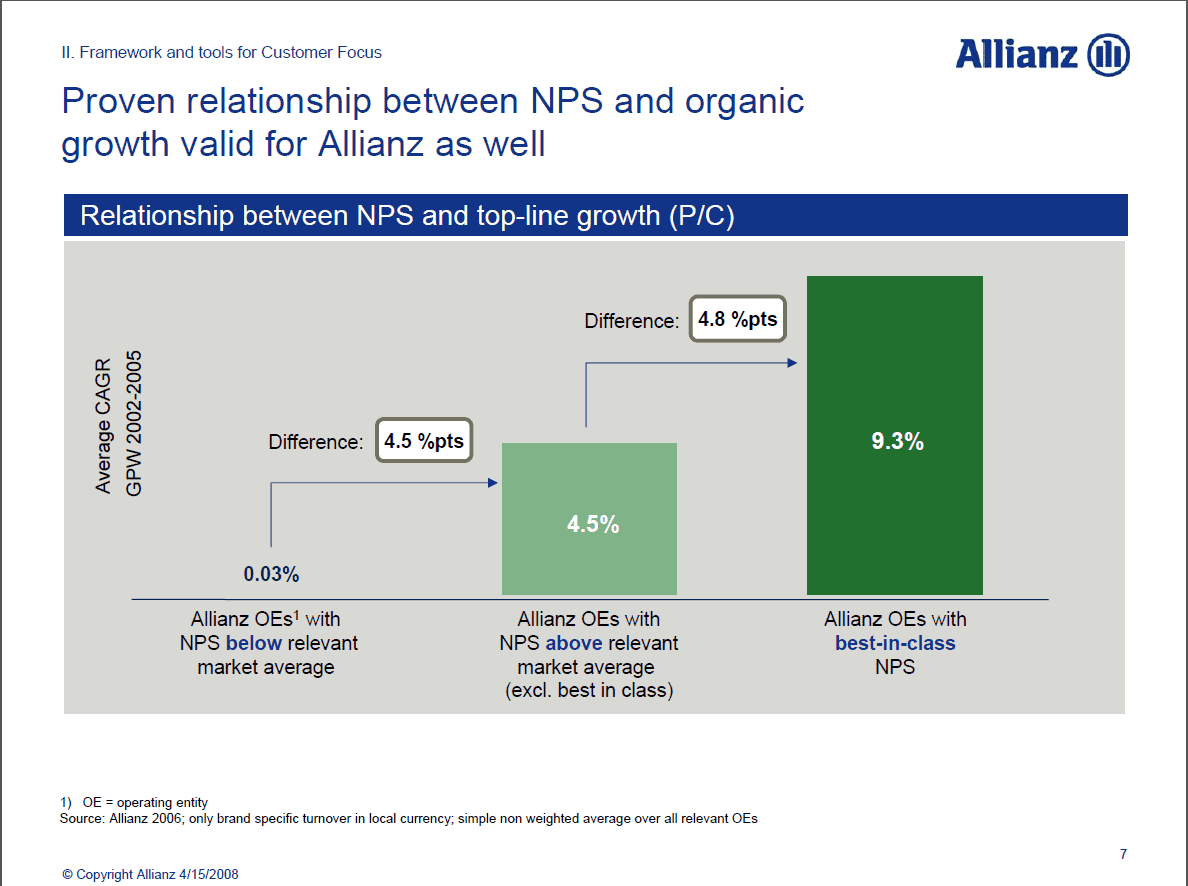
One of the key advantages of NPS is that a company’s relative Net Promoter Score versus its competitors is a predictor of future business revenue growth.
Net Promoter Score uses a Likert Scale question as part of the process – this is the so called “would recommend” question.
The scales is denoted with numbers but anchored at each end by words that are at opposites making it a Likert Scale. The ends of the “would recommend” scale are denoted: Unlikely and Very Likely.
It is also 11 points long instead of seven or five points.
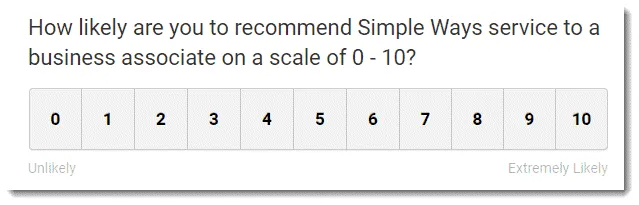
The Likert Scale Question used in the Net Promoter Score Process
Rather than directly reporting the score from the Likert Scale, NPS is calculated as the difference between proportions of responses.
Net Promoter Score is calculated by subtracting the percentage of 0-6 responses (Detractors) in the “would recommend” question, from the percentage of 9 and 10 responses (Promoters) to give an overall score between -100 and +100
Here is the NPS calculation in a formula:
Similarities between Likert Scales and Net Promoter Score
The underlying “would recommend” question that is used to generate the Net Promoters Score is in fact a Likert Scale question. So NPS is built on the Likert Scale.
But as noted above the data is analysed in a way that creates a -100 to +100 score, rather than a 0-11, 1-7 or 1-5 score.
Differences between Likert Scales and Net Promoter Score
The key differences between Likert Scales and Net Promoter Score are:
- Calculated Vs non-calculated: NPS is a value calculated from a Likert Scale responses, not a scale response in itself.
- One specific question vs applicable to many questions: NPS is one specific question, the “would recommend” question where as Likert Scales can be used by many different questions: customer satisfaction, customer loyalty, service performance and more.
FAQ
Can you calculate NPS using a 5 point Likert Scale?
It is possible to use a 5 point Likert scale in place of the 11 point Would Recommend question scale. In this case 1-3 becomes Detractors and 5 becomes Promoters. The only issue is that you lose the “0” response if you use a 5 point scale. The “0” response is considered very important in Net Promoter Score data Analysis so it’s loss reduces the effectiveness of the system.
Which is Better Likert Scales or Net Promoter Score
Proponents of Net Promoter Score argue that the calculation performed on the raw Likert Reponses make it better predictor of customer loyalty than the raw “would recommend” question response.