Easy Steps to Optimise your Homepage for Lead Conversion
Most B2B homepages try to do everything for everyone, and end up doing very little for anyone. The fix is the unglamorous one: focus on the primary buyer persona, lead visitors down one path, organise the menus around that path, and ruthlessly cut. Here are the steps to optimise a homepage for lead conversion, including how many CTAs is the right number.

On this page
What is the aim of your homepage?
Conversion and education are key points to optimise your homepage in B2B marketing. But you need to be realistic and think about why people may visit it. The most likely reason is to gain a better understanding of what your business is about.
So, make your business, and its products and services, easy to understand with as few words as possible. That is why concise copy is so important for a homepage. Too many words will lead to higher bounce rates and make leading them down a path more difficult.
Focus on your primary Buyer Persona
Few businesses will have only one buyer persona. The complexities of B2B businesses usually mean you will have at least 3 buyer personas, if not more depending on how many products and solutions you many have.
However, there will be one main persona that may either provide the greatest return, have the lowest overheads, be the easiest to convert to a sale or prefers your top grossing product or service.
Figure out which one is yours and make sure the content used in your homepage can speak to this persona, with some reach to the other personas.
Lead your visitors down a path so that they make the right decisions
Many people make the mistake of providing their website visitors with all the options available for their business, allowing them to make all their own decisions on what they want to find.
Although this may seem organised and logical, it doesn’t optimise your homepage for inbound conversions.
This goes back to the first point in this blog. Deciding on the aim of your homepage. Was your aim to make clear what all the available options are in your business in the most organised way? Nope. It was probably something more like, to optimise your homepage for lead generation. So make your homepage about that.
Consider how your Menus will be Organised
Your menu will likely need some of the classics that everyone is used to so that About Us can be found when being searched for. The classics include:
- About Us
- Location (if this doesn’t come under about us)
- Testimonials
- Contact Us (Also could be under About Us)
- Services
Organising your Services
As tempting as it may seem, don’t just list them all down in a drop down menu.
If you have a more complex set of services, its best to organise them in a way that will seem logical to your prospects. This will optimise your homepage by reducing the amount of time your prospects spend searching for what applies to them.
So if one particular prospect can benefit from a handful of your products and services, place them all under one sub-heading of services so that it will be easy for a prospect to find all that is relevant to them.
Have clear CTA’s- How many should you have?
Decide on the focus of your CTA’s. You can opt to have a series of CTA’s based on one of the following
- Pain points
- Buyer personas
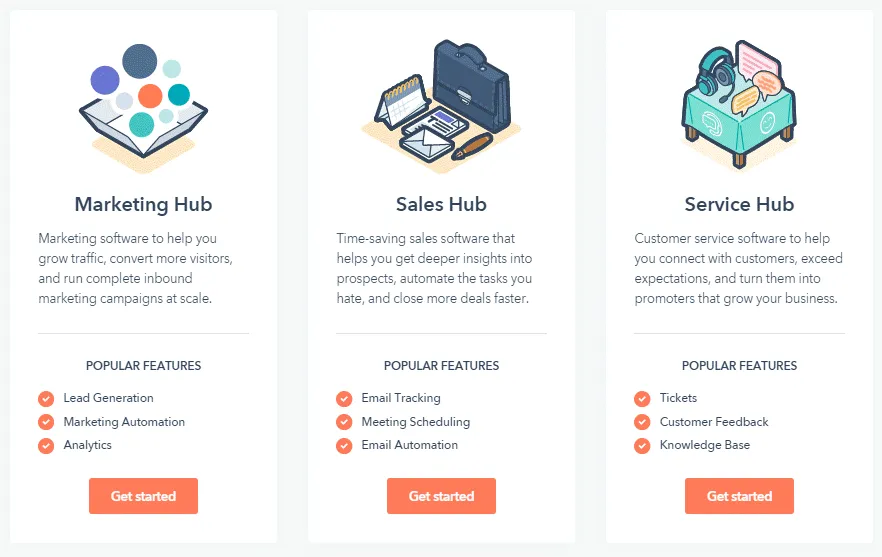
- Business type (this applies for businesses that have specific solutions for different business types. E.g. healthcare and transport or small business and large corporations. Hubspot exemplifies this by focusing their CTA’s on packages that suit specific areas within a business.
Provide Social Proof
There are a few things you want to achieve when a prospect arrives at your site. One of them is to confirm that you have what they are looking for, the next is to establish trust as soon as possible.
Don’t make the mistake of having them look for it. Place one of your best video testimonials on your homepage. If you don’t have high-quality video capability on your homepage, then high impact and concise text quotes will do. Make sure it leads to a more detailed testimonial.
Keep it Clean
Design and colour should make for easy reading, reflect your branding and allow your reader to focus on one idea at a time. So keep to one idea in each block. Exclusions apply to the header and footer where you need to provide easy navigation to the rest of the website.
Ensure a smooth-end-to-end experience.
Whichever buyer persona you choose to focus on, you need to put yourselves in their shoes and make sure that no matter what they do, they have a nice experience on your website. This includes whether or not they convert right away. If they don’t, what happens next? Do they leave the website without any more future contact?