How to Use SMS Messaging To Drive Better Customer Experiences
SMS keeps showing up in customer experience programs because the open rates and response times are hard to argue with. Used badly, it's an interruption. Used well, it's a convenience customers come to rely on. Here are seven concrete ways to deploy SMS that improve B2B customer experience without becoming a nuisance.
On this page
SMS messaging continues to grow in popularity as a tool for businesses to talk to customers. Texting has unique benefits as a communication method that enables it to change and improve customer service to offer a better overall customer experience.
Higher open rates and faster response times are some of the obvious benefits that businesses focused on continuous customer experience improvement can’t ignore, but more importantly, it can contribute to a more convenient, streamlined, and personal service for your clients.
In this post we look at seven ways to use SMS messaging to improve your B2B customer experience.
Key Takeaways
- SMS is a powerful tool for enhancing customer experience with high engagement rates.
- Personalization in SMS messages significantly increases customer satisfaction.
- Timely and relevant SMS alerts and reminders boost customer trust and reliability.
- Automated SMS workflows streamline customer interactions, saving time and resources.
- Integrating SMS into the customer journey offers a seamless, omnichannel experience.
- Measuring the impact of SMS campaigns is crucial for continuous improvement.
- Compliance and respecting customer preferences are vital for successful SMS marketing.
Alerts and Reminders
Using text messaging to provide alerts, notifications, and reminders to your customers can improve the experience of using many B2B services. These can enable both you and your clients to react faster to critical issues, especially when time is an important factor.
An email can take hours for a client to open, which isn’t always fast enough. Sending text messages online to recipients can improve the customer experience when delivering a wide range of time-sensitive alerts and reminders, for example:
Service Outages
When your services experience an outage or failure, your clients may need to respond quickly to minimize the impact on their business.
An SMS alert can notify them of a problem in minutes, ensuring customers are not left in the dark when an important part of their business goes offline. Nobody likes delivering bad news to their clients, but proactively providing fast, regular updates on the issue helps manage the customer experience during a service issue.
Changes and Updates
Text alerts can inform clients about upcoming changes and updates to how their services work, allowing their business to plan for how changes might affect their workflow.
An alert when a change or new feature goes live can help clients get to grips with the changes and learn about new services they can use.
For major updates, it can be more convenient to link to a web page or refer to an email rather than give the full details over text. The good news is, some email marketing platforms give you the ability to do both.
Meeting and Appointment Reminders
Between 40% and 50% of business meetings start late.
Clients forgetting meetings and other important dates can cost your business a lot of time and money, but they also negatively impact your customer’s experience.
Being late or unprepared for a call can make the discussion less productive. For example, if you had a scheduled discussion of a time-sensitive project, a missed meeting could cause a costly delay to the project.
Sending Confirmations
Similarly, there are plenty of situations where you need to share a document or contract quickly and get confirmation from your client to get a project moving.
Attaching the file to a text notifying clients about an email with the full documents can enable them to respond faster.
Subscription and Payment Reminders
It can be easy to forget when a subscription payment is due, especially if they are paying on a yearly basis or longer.
A polite reminder text when a created invoice or payment is coming up or overdue helps those clients avoid the inconvenience of temporarily losing their services due to non-payment.
Instant Accessibility
One of the most valuable uses for SMS messaging is in making your business more immediately available and accessible to your customers.
The speed at which customers can get an effective response when they need help or information from your business has a big impact on how they feel about their customer experience. In fact, a Forrester survey shows that 77% of people say that valuing their time is the most important thing a business can do to provide good customer service.
While most businesses are not able to offer live support around the clock, an SMS service can fill the gaps when your customer service team is offline. Automated text responders and chatbots can provide instant answers to many basic queries and carry out simple tasks in response to keywords at any time.
Besides providing 24/7 support, providing the option of SMS help can take the strain off your live support channels by automating the simple tasks to enable your customer service team to focus on the more complex requests and problems that need the attention of a live staff member.
In this 2019 survey, B2B buyers rated self-service tools as the most important feature for a positive experience. Clients actually prefer to use self-service resources when possible, so adding this option is an upgrade to their customer experience as well as a boost to your own efficiency.
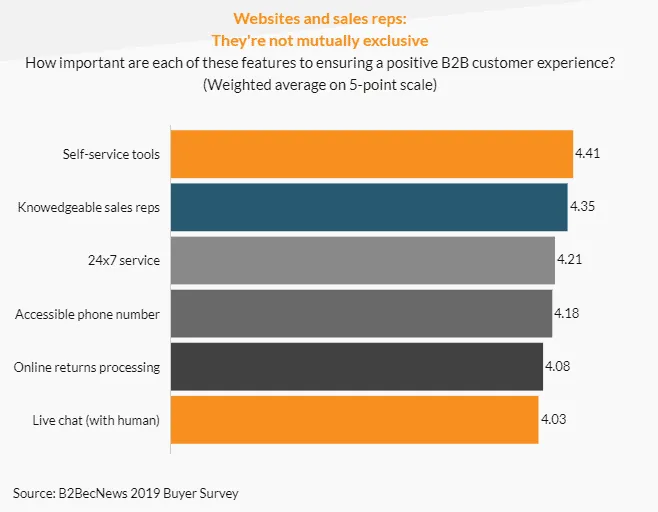
The Importance of Different Service Features to B2B Customer Experience (Source)
Personalization
Providing more personalized service is a key part of using SMS messaging to improve your customer experience.
At a basic level, this means enabling clients to customize which messages and notifications they receive in order to tailor their experience to their business needs. This is an important starting point as overuse or misuse of contact methods like text and email can have a negative effect on customer experience.
However, you can also use SMS to send personalized information, offers, and recommendations based on how they use your services. You can use a text messaging service to automate all the processes and manage your bulk SMS campaigns.
For example, by creating an SMS mailing list for your clients running ecommerce businesses, you can reach out to these customers with content and upsell offers that are more relevant to their needs, such as suggesting features of your service that can help them.
Focusing on relevant, personalized messages also has the resultant effect of increasing your overall open rates. While customers are more likely to ignore your messages when the content doesn’t matter to them, when every message is important to their business they are more likely to read every message.

Alexa Lemzy is the customer service specialist and content editor at TextMagic. She focuses on customer support solutions, small business growth, and internal communication. Follow her on Twitter.