7 Reasons Your Net Promoter® Program is Failing: And How to Fix It
"We tried Net Promoter and it didn't work." Almost every time someone says that to me, it comes back to a small number of fixable implementation mistakes — no C-level buy-in, treated as market research, no root cause analysis, score collected and nothing done. Here are the seven, and how to correct each one without restarting the program.

On this page
Sometimes I chat to people who have tried Net Promoter but found it didn’t deliver the business value they were hoping for, so they ditched the whole idea as a waste of time.
After discussing it with them I find it pretty much always comes down to a small number of, easily correctable, mistakes in their implementation.
So if you’re having issues driving business value with your Net Promoter programme check out this list of issues and how to correct them.
You Lack “C” Level Buy In
If your “C” Suite are not convinced of the ability of Net Promoter and Customer Experience (CX) to make pretty substantial improvements in business value you will struggle to be successful.
Rolling out an effective NPS programme requires staff time, investment and focus. If the “C” suite are not on-board, they can starve the program of required resources, causing it to falter.
However, in this case, I lied, this is not always an easy fix.
You will need to educate the “C” suite on the value of CX improvements. Here are two resources that might assist:
Wolters Kluwer Asia Pacific: CEO insights- Allocating the right resources with Net Promoter
Wolters Kluwer Asia Pacific: CFO Insights- The correlation between increasing scores and financial growth
You Made it a Market Research Project
There are plenty of good market research approaches but Net Promoter is not one of them.
As a transactional customer feedback tool, NPS® excels. It helps you to uncover high impact customer issues and identify how to fix them.
The role of the customer feedback program is to maximize the value of the existing business platform and customers.
However, market research is about building the product or service from scratch rather than improving it in an incremental manner. There are many other differences which means that NPS is not market research.
Customers responding to transactional customer feedback surveys will tell you that you failed to deliver your widget to them on time, or that your web check out is too hard to use.
They will tell you exactly where the problem is and often how to fix your existing product or service.
However, it is not market research and it will fail if you try to make it do that task.
You Tried to Explain Every Change in NPS
We’ve all seen them; the chart showing the NPS target for the month, the gap to actual and the attempt to post-hock justify the difference in the chart comments.
Just don’t do it. This doesn’t work for two reasons.
Statistical noise
Net Promoter has some curious features and care needs to be taken to be sure you really know when a change has occurred in the Net Promoter score.
What looks like a change may just be statistical noise and not worth commenting upon.
If you are reasonably sure (95%) that a change has occurred you may run into the second issue.
Many Things Impact on NPS
Tracking exactly what has impacted on your score is not like doing the variance report on the last widget production run.
A single factor, like Bob in shipping being off sick this month, is not likely to drive a change in your score. The items that might impact on a single month’s NPS are many and varied and you cannot always link changes to specific external factors.
(This is not always true, some of our customers see distinct seasonality in their scores as annual factors drive the score up and down. In this case the are quite sure that those factors are driving the score)
However, you should still analyse you NPS, but focus on the trend. The trend is your friend. Look to see how the score is moving over time. Is it generally increasing or decreasing?
You Tried to Make it a Discontinuous Innovation Tool
The difference between discontinuous and continuous innovation is stark.
Net Promoter is a very good continuous innovation tool. It can help you to make continuous changes to your business to improve customer loyalty and lower costs.
What it does not do so well is discontinuous innovation: coming up with radical, never been seen before ideas, like the automobile (in the late 1,800’s), the iPAD, Walkman, smart phone, etc.
I say “not so well” because recently a customer told me they estimate;
1 in 1,000 customer comments is the gem of an idea for a discontinuous innovation opportunity.
So it’s not impossible, it’s just that you should not be relying on it.
You Collected Scores but Did Nothing Else
You’re collecting NPS week after week, month after month but the score just doesn’t improve!?
Well of course not. Weighing a pig doesn’t make it fatter.

Weighing a pig doesn’t make it fatter!
It is not enough to add the “would recommend” question to your current customer survey. You have to collect the score AND information on why customers gave you that score AND you have to make some changes in your business.
This is the key. NPS is just a way of identifying what you need to change.
To improve NPS you have to make change within your organisation and it is only the qualitative feedback, and perhaps scored attribute questions, that can help you to do that.
You Didn’t Do any Root Cause Analysis
Okay so you’re knee deep in data and you’ve got verbatim customer comments flowing down the sides of your desk. So what.
Now you have to make sense of all that data and do some root cause analysis. To do that you probably need to use some quality system tools like “The Five Whys“.
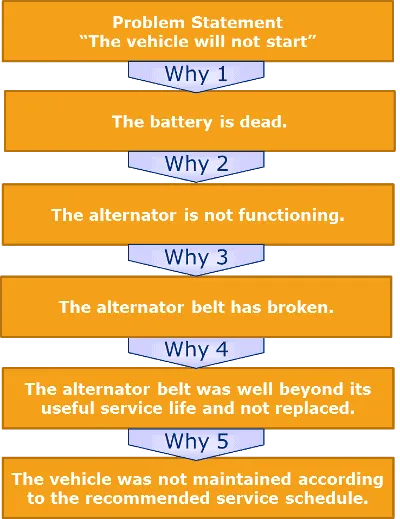
The 5 Why’s Process
You Never Worked out how Much a Promoter is Worth
You collected some great data and performed a really excellent root cause analysis process.
The result was a terrific opportunity to improve the NPS but management refused to sign off on the funding because you couldn’t justify the ROI.
Did you calculate the value of a Promoter and factor that into your business case?
Often it is not difficult to do this calculation, we published an example of how to value a promoter.
The trouble is that without this piece of information you will be hard pressed to make any business case watertight.