How to Build a Great Digital Marketing Funnel for B2B
The buyer's journey and the digital marketing funnel get used interchangeably, they shouldn't be, and the confusion costs you. The journey is what the buyer does; the funnel is what you do about it. Here's the side-by-side, then a stage-by-stage walk-through of the digital marketing funnel, awareness, consideration, decision, loyalty, advocacy, with the assets and metrics each stage needs.

On this page
The difference between a Digital Marketing Funnel and a Buyer’s Journey
You might assume that a digital marketing funnel and a buyer’s journey are the same thing but that would be falling short on a lot that the marketing funnel can achieve for you. Although they have some similarities, it is critical to have both of these tools in your B2B marketing arsenal.
Here’s why.
The buyer’s journey is a flow chart of the thought process that your buyers go through before they make the decision to purchase something from your business. It’s what you use to understand your prospect, and build yourself a well-informed marketing funnel.
A marketing funnel describes the marketing tactics you use to address each stage of the buyer’s journey.
They are both important and certainly not the same.
This blog is about the digital marketing funnel. It includes the description of the different stages, and the features and assets of each stage of a good marketing funnel. We include a listing of what you need to do to move your prospects from one stage to the next.
So let’s jump right in.
There are five main stages to a marketing funnel, three of them come before the purchase. Let’s start with awareness.
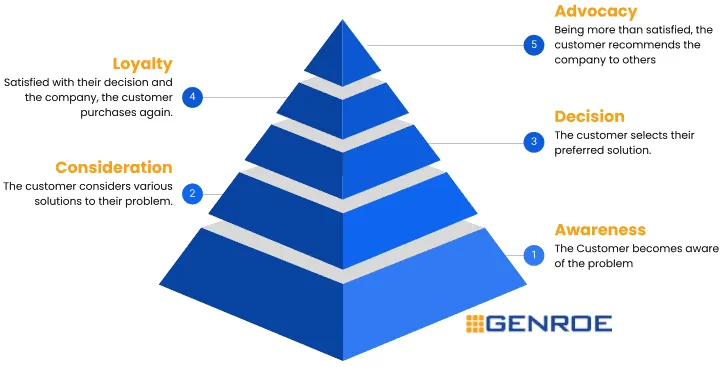
Digital Marketing Funnel
Awareness
Awareness is a strictly no-sale stage. It’s all about helping the prospect understand their problems.
This is the stage where you offer education and provide them with value in their problem area. Help them so they take notice of your company.
Features of a good Awareness stage:
- A strong following on social media (LinkedIn and Facebook) with regular posting that receives engagement.
- A few campaigns running simultaneously with different ToFu (Top of the Funnel) offers on landing pages. (eBooks, how-to’s, checklists, guides)
- Campaigns and landing pages need to focus on collecting contact information of new prospects.
- Use of paid, owned and earned media to attract the right traffic to your campaigns.
Consideration
At this stage, the prospect will know what their problem is and are now considering the kind of solution they can use to fix it. One of their considerations will likely be your company and one or two of the solutions you have to offer.
At this point, you should have gathered some information about all of your prospects and understand how their needs differ. With this knowledge, you can send a few problem- specific testimonials their way and make your content more targeted to their needs.
Features of a well executed Consideration Stage:
- A list of contacts that have problems that lie in your area of expertise
- A CRM that allows you to contact them and collect information on their demographics and marketing activity
- A few email marketing campaigns that focus on pain-points, allowing you to send more targeted emails to your prospects
- Emails containing resources that are still educational but with more focus on your products, solutions and brand integrity.
Decision
Once the more targeted content has been distributed amongst your pool of prospects, you’ll know which ones show interest with their levels of engagement. It’s time to start selling.
Send these marketing qualified leads (MQLs) information about the products and services you offer and your unique selling point. Make them aware why you are a good fit for them and why they should invest time and money in your business.
Features of a good Decision Stage:
- Email series offering free trials and product information
- Invitations to live webinars about problems and solutions where attendees can have their questions answered and you can reach out to those who ask buying questions
- Offer limited time and special offer discounts to subscribers to encourage a decision
Loyalty
Once you’ve gained a new client, don’t forget about them! Keep in touch with them via regular emails even if you are in a client facing business. Continue to offer helpful information, customer discounts and loyalty programs to keep them engaged in your business.
The point of this stage is to remind them through action how much you value them and how valuable you are.
In addition, existing clients and customers are the easiest to up-sell and cross-sell to because they already trust your company.
Features of a good Loyalty Stage:
- Weekly or fortnightly emails with helpful content
- Well defined existing customer mailing list
- Special discounts and offers exclusively for loyal customers
- A loyalty program that offers ways to redeem more value from their subscriptions
- Clear communication on their existing subscriptions
- Reactive and caring customer service
Advocacy
Done right, advocacy can be one of the most profitable stages of the marketing funnel.
After you’ve spent some time nurturing your loyal customer base, you need to figure out who in your customer base will be willing advocates of your brand.
Features of a good Advocacy Stage:
- Surveys to identify advocates
- Emails to advocates encouraging them to refer your business to their friends
- Surveys to existing customers at various stages of the sales and marketing process for feedback on their customer experience journey
- Incentivised loyalty and affiliate programs to encourage referrals
The best way to do this is through a Net Promoter Score program which helps you to achieve the many moving parts of a well-functioning customer loyalty program.